Fes is one of the most extraordinary cities in the world. Founded in the 9th century, it is home to the oldest university in continuous operation (the University of al-Qarawiyyin, established in 859 AD), a UNESCO-listed medina of staggering complexity, and crafts traditions that have remained virtually unchanged for a thousand years. Visiting Fes is unlike anything else in Morocco — or anywhere else on earth.
Here is your complete guide to the best things to do in Fes, with practical logistics for each.
Explore Fes el-Bali
Fes el-Bali — "Old Fes" — is the world's largest car-free urban area and arguably the most complete medieval city still inhabited on the planet. Declared a UNESCO World Heritage Site in 1981, it contains roughly 9,000 streets and alleyways, some barely wide enough to squeeze through sideways.
Navigation is part of the experience and part of the challenge. Forget Google Maps — it largely gives up inside the medina. The two main arteries, Talaa Kebira and Talaa Seghira, run roughly parallel from the Bab Bou Jeloud gate (the "Blue Gate") down toward the tanneries. Almost everything worth seeing branches off these two streets.
What to expect: The medina is a fully functioning city, not a museum. You will navigate past schoolchildren, delivery donkeys loaded with gas canisters, women carrying bread to communal ovens, and artisans hammering copper in workshops no bigger than a closet. The sensory overload — sounds, smells, colors — is overwhelming at first and intoxicating once you surrender to it.
Essential areas to explore: - Bab Bou Jeloud (Blue Gate): the main entrance to Fes el-Bali, decorated with zellige tilework in blue (Fes's color) on the exterior and green on the interior - The Andalusian Quarter: on the east bank of the Oued Bou Khrareb, founded by refugees from Córdoba — less touristy, more authentic - The Mellah: the historic Jewish quarter in Fes el-Jdid, with its distinctive high-windowed houses and the Ibn Danan synagogue (free entry) - Place Seffarine: the square of the coppersmiths, where craftsmen beat brass and copper into intricate shapes — the noise is extraordinary
Allow yourself to get lost. The medina is large but not dangerous, and getting lost is genuinely one of the best ways to discover it.
Visit the Chouara Tanneries
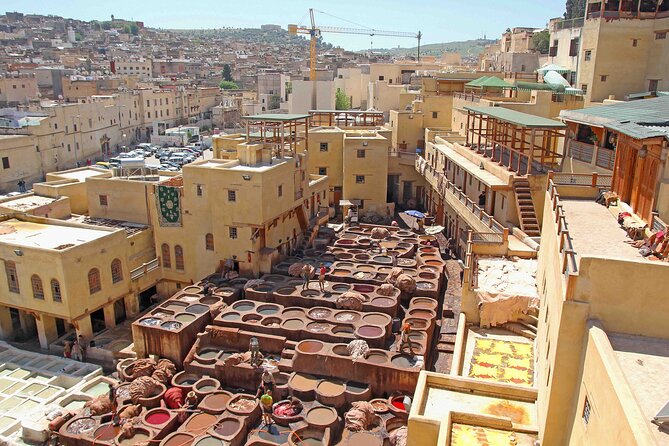
The Chouara Tanneries are the most iconic sight in Fes and one of the most visually arresting in all of Morocco. From above, the circular vats of dye — arranged like a painter's palette in shades of saffron, terracotta, red, green, and white — create an image that has barely changed since the 11th century.
How the tanneries work: Freshly salted hides arrive each morning. They are first soaked in white vats of pigeon guano (which softens the leather), then stretched and scraped by hand, then moved to the colored vats where they soak in natural dyes — poppy for red, indigo for blue, saffron for yellow, mint for green, henna for orange. The process takes weeks. Workers stand knee-deep in the vats for hours.
Finding the best viewpoint: The tanneries are best viewed from the leather shop terraces that surround them. Most shops will invite you up for free (with the implicit expectation that you'll browse their goods afterward). The best views are from shops on the north and east sides. Arrive mid-morning (9h-11h) when the vats are most active and colors most vivid.
Practical tips: - Shops offer sprigs of fresh mint to hold under your nose — accept them. The smell of the tanning process is powerful. - The best light for photography is mid-morning with the sun behind you (if you're on the north terrace) - You are under no obligation to buy anything, but browsing is expected. Leather goods here — bags, babouches (slippers), belts — are genuinely good quality and cheaper than in the souk. A pair of babouches costs 80-150 DH, a quality leather bag 300-800 DH - Tipping the terrace guide (not the shop owner) 20-30 DH is customary if they gave you a good explanation
There are also the smaller Sidi Moussa Tanneries near the Andalusian mosque — less visited and less spectacular, but you can often watch from ground level without going through a shop.
Historic Madrasas
Fes was for centuries the intellectual capital of the Islamic world, and its madrasas (religious schools) are among the finest examples of Islamic architecture anywhere. Two stand out.
Medersa Bou Inania
Built between 1350 and 1357 by the Marinid sultan Bou Inan, the Medersa Bou Inania is the most elaborate and best-preserved madrasa in Morocco. It is also the only madrasa in Fes that functions as an active mosque, which means non-Muslim visitors must be respectful of prayer times.
The interior courtyard is breathtaking: the lower walls are covered in intricate zellij tilework (geometric mosaic), above which rises a band of stucco carved with Quranic inscriptions, and above that dark cedar wood latticework up to the skylights. The proportions are perfect. Student cells on the upper floors are sometimes open to visit.
Hours: 9h-18h daily. Entry: 70 DH.
Medersa Al-Attarine
Steps from the Karaouiyne Mosque, the Al-Attarine Madrasa (built 1323-25) is named for the spice souk it adjoins. Smaller than Bou Inania but equally refined, its interior courtyard displays perhaps the most flawless zellij and stucco work in Fes. The carved cedar cornice is particularly remarkable. From the upper terraces, there are views over the rooftops of the medina.
Hours: 9h-17h daily (closed during Friday prayers). Entry: 20 DH.
Note: The Karaouiyne Mosque and University itself is closed to non-Muslims, but you can glimpse the courtyard through the many open doorways around its perimeter — particularly beautiful at dusk when the marble is lit by warm light.
The Fès Food Scene
Fes has arguably the most sophisticated culinary tradition in Morocco. The city's cooking is richer and more complex than Marrakchi cuisine, with influences from Andalusia, the Middle East, and sub-Saharan Africa.
Signature dishes to try: - Pastilla (bastilla): the iconic Fassi pie — thin warka pastry filled with pigeon (or chicken) in a sweet-savory blend of spices, almonds, and cinnamon, dusted with powdered sugar. A cultural landmark. Budget 60-120 DH at a good restaurant. - Rfissa: a celebratory dish of msemmen (layered flatbread) soaked in a rich broth of chicken, lentils, fenugreek, and ras el-hanout spice blend. Usually only available Friday or on order. - Harira: the ubiquitous Moroccan soup — tomato, lentil, chickpea, herbs, and lemon — served with chebakia (honey pastry) for 5-10 DH at street stalls, especially at sunset during Ramadan - Mechoui: slow-roasted lamb, sold by weight from open-air rotisseries near Bab Guissa for around 80-100 DH/kg
Best food streets and spots: - Rue Talaa Kebira: lined with bakeries, olive sellers, and snack stalls. The communal bread ovens (farran) where locals bring their dough are fascinating to watch. - Restaurant Jnan Sbil (near Bab Guissa): excellent traditional Fassi cuisine, mains 80-150 DH - The food stalls at Bab Bou Jeloud: cheap, lively, good for people-watching. Tagine + bread + mint tea for under 40 DH - Café Clock (Derb el-Magana): an expat institution, famous for its camel burger and cultural programming — live Sufi music on Thursdays
Budget per meal: Street food 15-40 DH. Mid-range restaurant 60-120 DH. Upscale riad restaurant 150-300 DH.
Day Trips from Fès
Fes's central location in northern Morocco makes it an excellent base for day trips.
Meknes (45 minutes)
The "Versailles of Morocco," Meknes was Morocco's imperial capital under Sultan Moulay Ismail (1672-1727). The granary, stables (designed to house 12,000 horses), and the monumental Bab Mansour gate are stunning even in their ruined state. Meknes is less visited than Fes and has a refreshing lack of tourist hustle. Combine with Volubilis for a full day. How to get there: grand taxi from Fes (30 DH, depart from near the bus station) or CTM bus.
Volubilis — Roman Ruins (1 hour)
The best-preserved Roman ruins in Morocco, Volubilis was a thriving city of 20,000 inhabitants at its peak in the 3rd century AD. The mosaics — particularly the Labors of Hercules and the Ephebe Riding a Dolphin — are extraordinarily detailed and still lie in situ on the floors of ruined villas. The triumphal arch, the forum, and the capitol are all impressive. Entry: 70 DH. Best time: early morning for cool temperatures and good light. Usually combined with Meknes.
Ifrane — "Morocco's Switzerland" (1 hour)
A strange and charming anomaly: Ifrane is a colonial-era resort town built by the French in the 1930s in the style of an Alpine village. At 1,650m altitude in the Middle Atlas, it has a distinctly European feel — chalet-style architecture, manicured parks, and occasional snow in winter. In summer, it's refreshingly cool (15-22°C when Fes is at 40°C). Worth a half-day visit combined with a drive through the cedar forests of the Middle Atlas, where you may encounter wild Barbary macaques foraging by the roadside.